
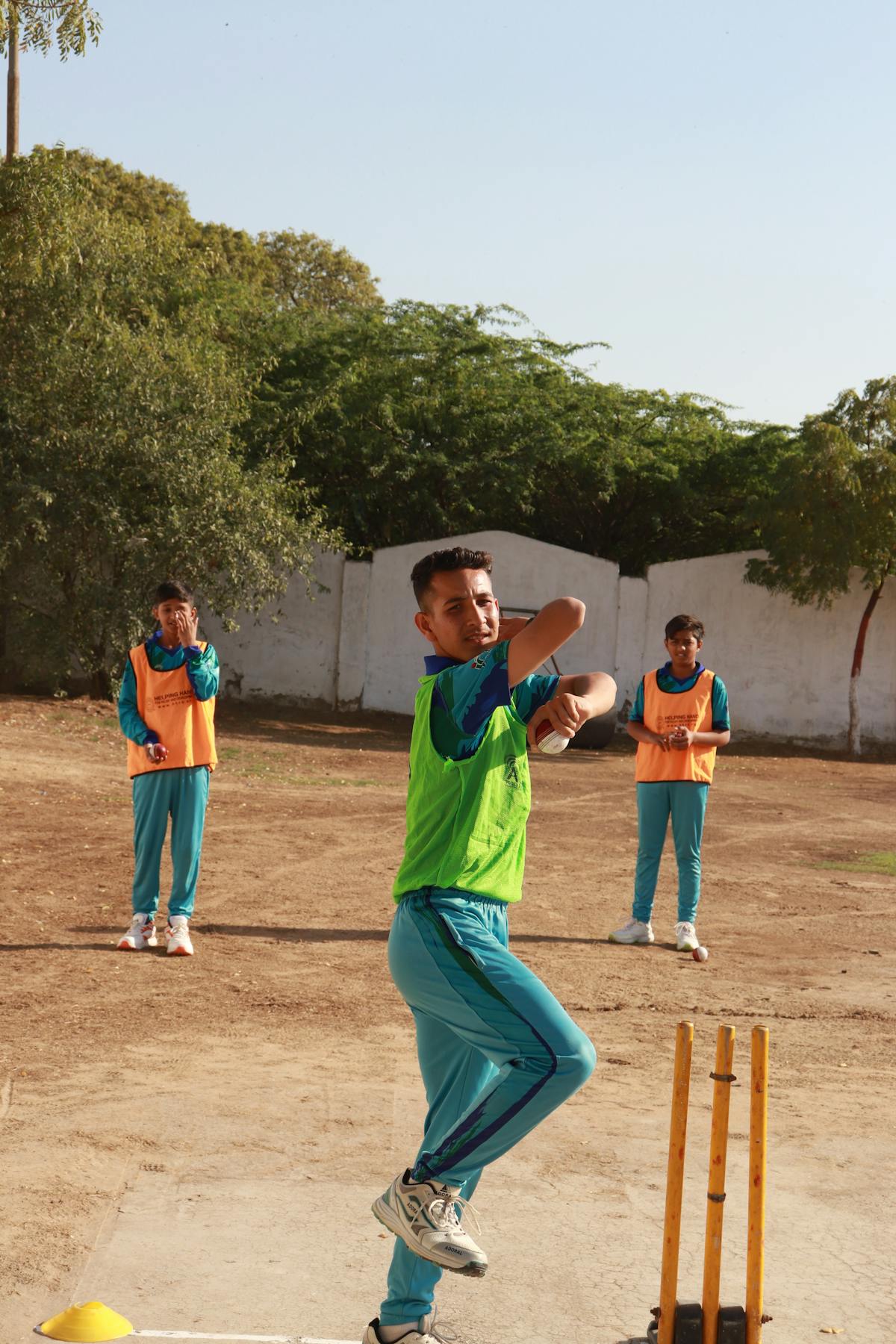
Walk past any open ground in Lahore, Karachi or Multan and you will see the same scene: a teenager in slippers, marking out a long run-up, hurling a worn tape-ball at a brick wicket. That image, repeated millions of times across the country, is the real explanation for one of cricket’s most stubborn statistics. Pakistan fast bowlers have terrorised batting line-ups for nearly five decades, and the assembly line keeps churning out the next great pacer.
From Imran Khan’s outswingers in the 1970s to Shaheen Shah Afridi’s left-arm thunderbolts today, the green shirt has worn many faces. What unites them is something deeper than coaching manuals or training camps. It is a pace culture rooted in the streets, in the dust, and in a national obsession with the ball going through, around and over the bat.
The Pakistan Pace Tradition Started With Imran Khan and Sarfraz Nawaz
Pakistan’s fast-bowling story does not begin with a coaching system. It begins with two men: Sarfraz Nawaz, who pioneered reverse swing in the 1970s, and Imran Khan, who turned it into a science. Sarfraz famously baffled English county batsmen with a ball that swung the wrong way under the lights of Old Trafford, and Imran spread the gospel from the Pakistan dressing room outwards.
Imran’s 1978–1992 captaincy era set the cultural template. He demanded pace, he respected the new ball, and he refused to apologise for aggression. By the time he lifted the 1992 World Cup at the MCG, an entire generation of Pakistani boys had decided what they wanted to be when they grew up, fast.
What Makes Pakistani Fast Bowlers So Different on the World Stage?
Pakistani fast bowlers are different because they are not manufactured, they are discovered. Most do not enter the system through age-group academies. They are spotted in tape-ball tournaments, club games or city leagues by a coach, a former player or a regional selector who notices the slingy action, the unusual wrist position or the simple fact that the boy bowls quicker than anyone around him.
That late, unstructured pathway preserves natural action. It also produces variety. Every great Pakistani pacer has looked subtly different: Wasim Akram’s whippy left-arm release, Waqar Younis’s late inswinging yorker, Shoaib Akhtar’s javelin-style sprint, Mohammad Asif’s metronomic seam, Naseem Shah’s wrist position. There is no template, only outcomes.
The Reverse Swing Revolution: Wasim, Waqar, and a Lost Art
If Imran Khan opened the door to reverse swing, Wasim Akram and Waqar Younis kicked it off its hinges. Their late-1980s and 1990s partnership terrorised batting orders from Adelaide to Trent Bridge. The ball would behave conventionally for 25 overs and then, suddenly, dip and curve as if remote-controlled.
The mechanics were not magic. Pakistan’s dry domestic pitches roughened one side of the ball quickly while the bowlers’ meticulous shining kept the other side glossy. That asymmetry, combined with high arms and wrist positions held until the last instant, produced movement that nobody could read.
Why Reverse Swing Travelled With Pakistani Players
Wasim and Waqar did not gatekeep their craft. They taught it openly to county teammates at Lancashire and Surrey, and the technique spread across world cricket. Today every elite seam attack carries a reverse-swing specialist, but the tradition was born in Karachi and Lahore, and Pakistan still does it best.
Tape Ball Cricket: The Streets That Built a Bowling Factory
The single biggest reason Pakistan keeps producing pacers is tape-ball cricket. A tennis ball wrapped tightly in electrical tape behaves nothing like a real cricket ball, it is lighter, swings more, and rewards an aggressive sling-arm action. Tens of thousands of tournaments are held every year across the country, often under floodlights deep into the night.
That ecosystem trains young bowlers to bowl long spells without fatigue, to attack the stumps, and to develop yorkers as a survival skill in death overs. Almost every modern Pakistani pacer, from Mohammad Amir to Haris Rauf, sharpened their craft in tape-ball before ever holding a red Kookaburra.
Modern Heirs: Shaheen Afridi, Naseem Shah and the New Generation
Shaheen Shah Afridi is the most visible face of the new wave. The left-arm quick from Khyber Pakhtunkhwa burst onto the scene as a teenager and now anchors Pakistan’s attack across formats. His full-length, swinging delivery to top-order batsmen has become a signature start to every Pakistan innings in the field.
Behind him stand Naseem Shah, Haris Rauf, Mohammad Hasnain and a steady drip of fresh talent emerging from Quetta, Multan and Peshawar. None of them came through a uniform pipeline. Each was identified through a regional tournament, a domestic season, or a Pakistan Super League draft pick that turned heads.
Why the Pipeline Hasn’t Run Dry, and Probably Won’t
The Pakistan Cricket Board has experimented endlessly with its domestic structure, but the pace pipeline has survived every reorganisation. The reason is simple: the talent is generated outside the formal system, in spaces the board does not control. The PCB’s job is essentially to recognise and refine, not to manufacture.
As long as tape-ball cricket dominates Pakistani streets, as long as Imran Khan and Wasim Akram remain cultural icons, and as long as a 16-year-old with a quick arm believes he can be the next Shaheen, Pakistan will keep producing pacers. That is not a coaching system. It is a national identity.
Key Takeaways
- Two pioneers, Sarfraz Nawaz and Imran Khan, built the tradition that all later Pakistani pacers inherited.
- Reverse swing originated in Pakistan and was exported to the rest of world cricket by Wasim Akram and Waqar Younis.
- Tape-ball cricket is the country’s true fast-bowling academy, producing yorker specialists and slingy actions.
- The current generation, Shaheen Afridi, Naseem Shah, Haris Rauf, continues the tradition without depending on a centralised system.
- The pipeline survives because it is cultural, not institutional.
Who is your favourite Pakistani fast bowler of all time, and which young pacer should the selectors give a longer run? Share your pick in the comments.